
How to verify a Chinese shiitake supplier is an important question for importers, distributors, food manufacturers, foodservice companies, and private-label buyers looking to source dried shiitake mushrooms from China.
China is a major source of dried shiitake mushrooms, with suppliers offering different grades, sizes, product forms, and packaging options. However, not every Chinese shiitake supplier has the same processing capabilities, quality control system, export experience, or supply stability.
Before placing an order, buyers should look beyond the price and verify the supplier’s company information, processing facility, raw materials, product specifications, samples, quality control, export experience, packaging, and long-term supply capability.
This guide explains how to verify a Chinese shiitake supplier and what international buyers should check before starting a new business relationship.
1. Verify the Chinese Shiitake Supplier’s Company Information
The first step is to confirm that the supplier is a legally registered business.
Ask for basic company information, including:
- Full legal company name
- Business registration information
- Registered address
- Factory address, if applicable
- Main business activities
- Contact information
- Export company information, if different from the factory
In China, some suppliers operate through a production company and a separate trading or export company.
This is not necessarily a problem.
The important point is that the supplier should clearly explain the relationship between the production and export entities.
Buyers should know:
Who manufactures the product?
Who signs the sales contract?
Who handles the export?
Who is responsible for product quality?
Clear company information is the foundation for verifying a potential Chinese shiitake mushroom supplier.
2. Check Whether the Supplier Has Its Own Shiitake Processing Factory
One of the most important questions for buyers is whether the supplier has its own processing facility.
A supplier may be:
- A direct manufacturer
- A factory with an export department
- A trading company working with partner factories
- A combination of manufacturing and trading businesses
There is nothing inherently wrong with using a trading company. However, buyers should understand the actual supply chain before making a purchasing decision.
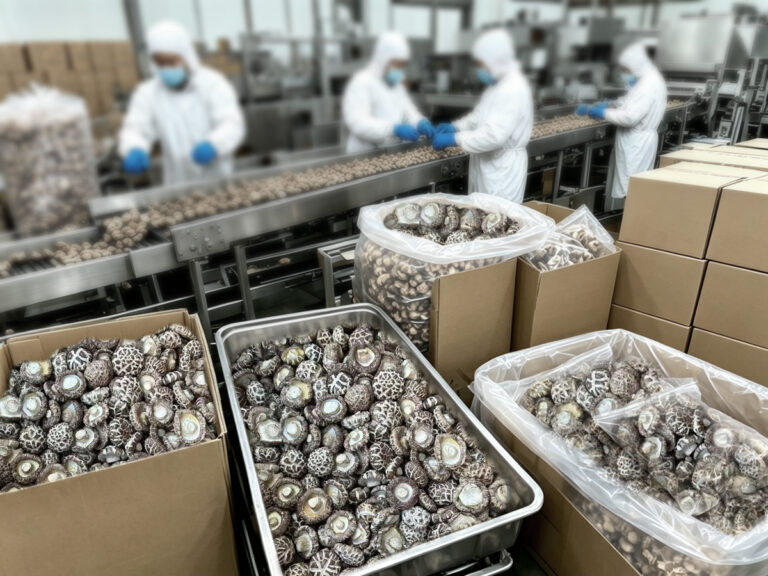
If a supplier claims to have its own factory, ask for evidence such as:
- Factory photos
- Processing workshop photos
- Production equipment
- Sorting and grading areas
- Warehouse facilities
- Packaging area
- Factory address
- Factory video
- Production capacity information
For larger or long-term projects, a factory video inspection or physical factory visit can provide additional confidence.
Why does the factory matter?
A supplier with direct processing capabilities may have greater control over:
- Raw material selection
- Processing
- Cutting
- Sorting
- Grading
- Quality inspection
- Packaging
- Production scheduling
This can be particularly important when buyers require consistent specifications over multiple shipments.
3. Understand the Source of the Dried Shiitake Mushrooms
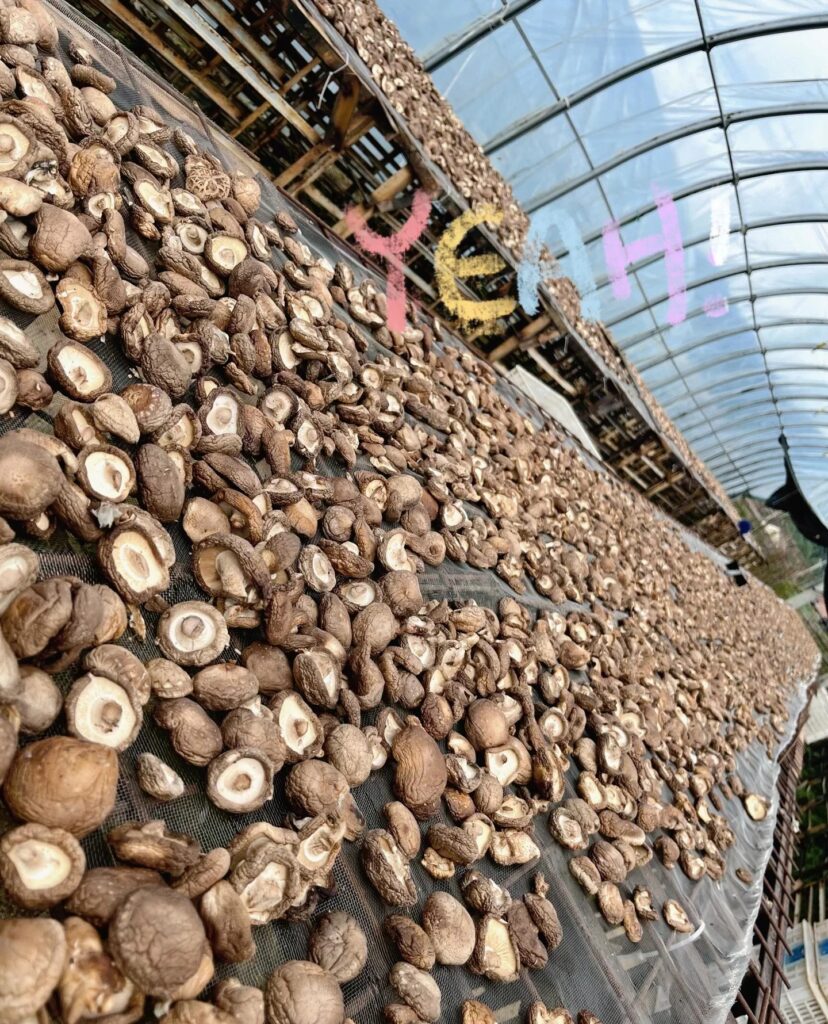
A professional dried shiitake supplier in China should be able to explain where its raw materials come from.
Ask:
- Where are the shiitake mushrooms produced?
- Does the supplier purchase directly from growers?
- Does it work with long-term raw material suppliers?
- What is the main production season?
- How are raw materials selected?
- How are raw materials stored before processing?
The origin and quality of raw materials can affect:
- Mushroom size
- Cap appearance
- Thickness
- Color
- Aroma
- Texture
- Moisture
- Overall consistency
For agricultural products, seasonal changes are normal.
A reliable supplier should explain these changes honestly rather than simply promising that the product will always be exactly the same.
4. Confirm the Exact Shiitake Product Specification
One of the biggest mistakes buyers make is comparing supplier prices without comparing product specifications.
For example, two suppliers may both offer:
Dried Shiitake Mushrooms — USD X/kg
But the actual products may have different:
- Grades
- Sizes
- Thickness
- Moisture specifications
- Appearance
- Defect rates
- Sorting standards
- Packaging
Therefore, buyers should define the required specification before comparing prices.
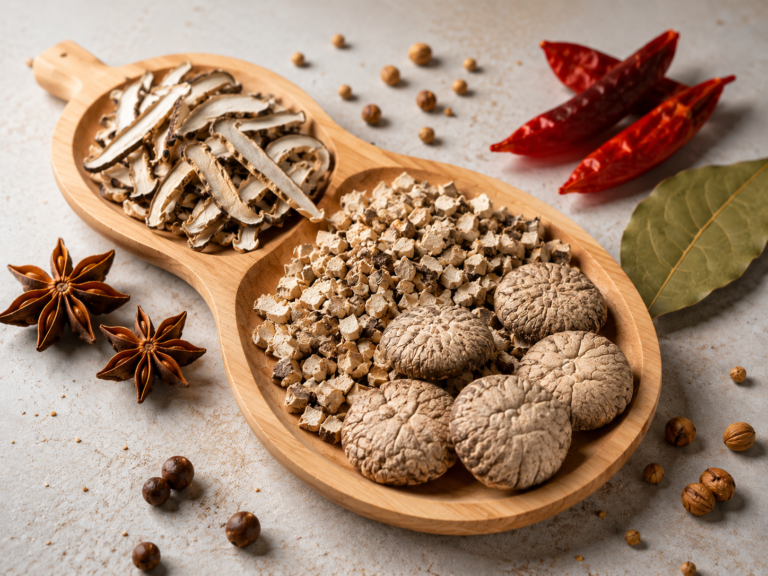
Depending on the application, the product may be supplied as:
- Whole dried shiitake mushrooms
- Shiitake mushroom strips
- Shiitake mushroom pieces
- Shiitake mushroom granules
Different forms are suitable for different applications.
Depending on the application, dried shiitake mushrooms may be supplied as whole mushrooms, strips, pieces, granules. [Different Forms of Dried Shiitake Mushrooms and Their Uses] explains the differences between these formats and their common applications.
For more information, see our guide:
Different Forms of Dried Shiitake Mushrooms and Their Uses
This helps buyers understand which shiitake format may be most suitable for their finished product.
5. Ask for Samples From the Chinese Shiitake Supplier
A sample is one of the most effective ways to verify a supplier.
[How to Choose Dried Shiitake Mushrooms: A Practical Buying Guide].
Before placing a large order, buyers should request samples based on the exact commercial specification.
When evaluating a sample, check several areas.
Appearance
Check:
- Color
- Cap shape
- Size consistency
- Thickness
- Broken pieces
- Visible defects
Aroma
Dried shiitake should have a characteristic mushroom aroma.
Any unusual odor should be discussed with the supplier.
Texture
If possible, soak or cook the sample according to the intended application.
Check the texture, rehydration performance, and overall eating characteristics.
For processed products such as strips and pieces, also check the consistency of the cut size.
Cleanliness
Check for:
- Soil
- Excessive dust
- Foreign materials
- Insects
- Other unwanted materials
Moisture
Moisture is an important specification for dried mushroom products.
Buyers should confirm the supplier’s moisture specification and request testing documentation when necessary.
Most importantly, buyers should ask the supplier to confirm that the sample represents the product that will be supplied commercially.
6. Evaluate the Supplier’s Quality Control System
A reliable shiitake supplier should have a practical quality control process.
The basic process may include:
Raw Material → Processing → Sorting → Grading → Inspection → Packing → Shipment
Ask the supplier how quality is controlled at each stage.
Important questions include:
- How are raw materials inspected?
- How are mushrooms sorted?
- How are grades separated?
- How is moisture checked?
- How is foreign material controlled?
- Is the finished product inspected before shipment?
- Are production and inspection records maintained?
Depending on the destination market and product, buyers may also need relevant food safety and laboratory documentation.
This may include:
- Product specifications
- Certificate of Analysis (COA)
- Microbiological testing
- Pesticide residue testing
- Heavy metal testing
- Other documents required by the importing country
The exact requirements should always be confirmed according to the destination market.
7. Check the Supplier’s Export Experience
A company may have good domestic sales experience but limited experience with international trade.
For international buyers, export experience is an important part of supplier verification.
Ask whether the supplier has experience with:
- Export documentation
- Customs procedures
- Commercial invoices
- Packing lists
- Certificates of Origin
- Container loading
- International logistics
- Destination-market requirements
You can also ask which international markets the supplier has experience serving.
The purpose is not necessarily to obtain a customer list.
Instead, the goal is to determine whether the supplier understands the practical requirements of exporting food products from China.
A supplier experienced in international trade will usually be more familiar with documentation, packaging, shipping schedules, and communication with overseas buyers.
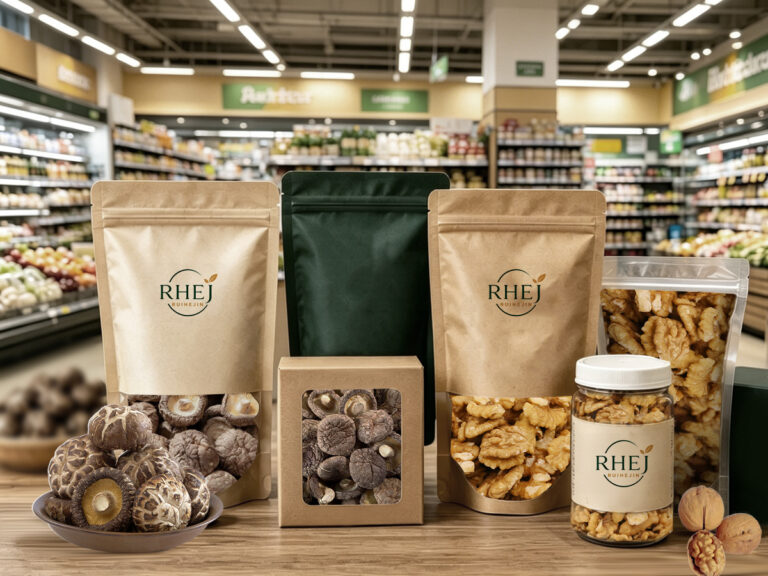
8. Check Shiitake Packaging and Private Label Options
Packaging should also be part of your supplier evaluation.
Depending on your business model, you may need:
- Bulk packing
- Foodservice packing
- Retail packing
- Vacuum packing
- Carton packing
- Custom bags
- OEM packaging
- Private-label packaging
If you are developing your own brand, ask about:
- Minimum order quantity
- Packaging materials
- Printing options
- Label requirements
- Artwork requirements
- Production lead time
A supplier capable of supporting both product specifications and packaging requirements may be a better long-term partner for importers and private-label businesses.
9. Compare Chinese Shiitake Suppliers Based on the Same Specification
Price is important, but price alone should not determine your supplier.
When comparing several Chinese shiitake suppliers, make sure you are comparing equivalent specifications.
A useful comparison includes:
Product + Quality + Specification + Packaging + Shipping Terms + Service + Price
For example, a lower quotation may be based on:
- Smaller mushrooms
- Different grade
- Higher broken rate
- Different moisture specification
- Simpler sorting
- Different packaging
Therefore, the lowest quotation is not necessarily the lowest total cost.
A better supplier comparison starts with a clear product specification.
10. Evaluate Communication and Professionalism
Communication is often overlooked when buyers verify a new supplier.
However, the way a supplier responds before an order can tell you a lot about future cooperation.
Pay attention to whether the supplier:
- Understands your requirements
- Answers questions clearly
- Provides complete quotations
- Explains product differences
- Responds within a reasonable time
- Provides requested documents
- Gives realistic production and shipping information
Be cautious when a supplier repeatedly uses phrases such as:
“Best quality.”
“Best price.”
“No problem.”
without providing specific information.
A professional shiitake mushroom supplier should be able to discuss actual specifications, production, quality control, packaging, and delivery.
11. Check Long-Term Shiitake Supply Capability
For a small trial order, price may be the main consideration.
For long-term cooperation, supply stability becomes much more important.
Ask:
- Can the supplier provide the same specification repeatedly?
- What is the available production capacity?
- How does the supplier manage seasonal raw materials?
- How are raw materials stored?
- Can the supplier support regular orders?
- Can the supplier increase production when order volume grows?
This is particularly important for agricultural products such as dried shiitake mushrooms.
Raw material availability and quality can change from season to season.
A professional supplier should be able to explain how it manages these changes.
12. Start With a Sample or Small Trial Order
After checking the company, factory, product specifications, quality system, and export capability, a small trial order can be a practical next step.
A trial order allows buyers to evaluate:
- Actual product quality
- Consistency with the approved sample
- Packaging quality
- Documentation
- Delivery performance
- Communication
- Commercial service
If the supplier performs well, the buyer can gradually increase the order volume.
This approach can reduce the risk of making a large purchase from a new supplier without sufficient experience.
Chinese Shiitake Supplier Verification Checklist
Before starting cooperation, buyers can use this checklist:
| Verification Area | What to Check |
|---|---|
| Company | Legal name and registration |
| Factory | Own factory or partner factory |
| Raw Materials | Origin and sourcing |
| Product | Form, size and grade |
| Quality | Moisture, cleanliness and consistency |
| Sample | Actual product quality |
| Food Safety | Testing and relevant documents |
| Export | International trade experience |
| Packaging | Bulk, retail or OEM |
| Price | Same specification for comparison |
| Communication | Professional response |
| Supply | Capacity and seasonal availability |
| Trial Order | Performance before larger orders |
The more important the order, the more carefully these points should be verified.
Questions to Ask a Chinese Shiitake Supplier Before Ordering
Before requesting a final quotation, buyers can prepare the following questions:
- What is your full company name?
- Where is your processing facility located?
- Do you have your own shiitake processing factory?
- Where do you source your shiitake mushrooms?
- What grades and sizes can you supply?
- What product forms are available?
- What are your moisture and quality specifications?
- Can you provide samples?
- What quality and testing documents can you provide?
- What packaging options are available?
- Can you support OEM or private-label packaging?
- What is your MOQ?
- What is your normal production lead time?
- Do you have experience exporting dried shiitake mushrooms?
- Can you support regular or long-term supply?
A professional supplier should be able to answer these questions clearly and provide supporting information when required.
Why Buyers Choose a Direct Chinese Shiitake Processing Supplier
For importers and food manufacturers, working directly with a processing supplier can provide several potential advantages.
These may include:
- More direct communication with the production team
- Better understanding of product specifications
- Greater control over processing and sorting
- More flexible product formats
- Easier communication about customized requirements
- Potentially more competitive factory-direct pricing
- Better support for OEM and private-label projects
However, buyers should still verify the supplier rather than assuming that every factory offers the same level of quality or service.
The goal is not simply to find a factory.
The goal is to find a reliable Chinese shiitake supplier that matches your product, quality, volume, packaging, and market requirements.
RUIHEJIN: Your Chinese Shiitake Processing Partner

At RUIHEJIN, we understand that international buyers need more than a simple product quotation.
They need a supplier who can clearly communicate about product specifications, processing, quality control, packaging, samples, and export requirements.
RUIHEJIN operates its own food processing facility in Shaanxi, China, with a focus on dried shiitake mushrooms and walnut kernels.
For shiitake, our current product range focuses on dried mushroom products and different specifications according to customer requirements, including whole mushrooms and processed formats such as strips and pieces.
We are also exploring a broader shiitake product and ingredient system, including granules, powder, seasoning, and future food applications.
For importers, distributors, food manufacturers, and private-label buyers, we can support:
- Dried shiitake product specifications
- Samples
- Quality information
- Factory information
- Bulk packaging
- Retail packaging
- OEM / private label
- Export quotations
- Customized product requirements
If you are looking for a reliable Chinese shiitake supplier, send us your required:
Product Form + Size/Grade + Quantity + Packaging + Destination Market
We can then recommend a suitable specification and prepare a quotation based on your requirements.
Final Thoughts
Choosing a Chinese shiitake supplier should not be based on price alone.
Before placing an order, verify the company’s identity, processing capabilities, raw material sourcing, product specifications, samples, quality control, export experience, packaging options, communication, and supply capacity.
A reliable supplier should be able to provide clear answers and consistent information throughout the purchasing process.
For long-term cooperation, the best supplier is not necessarily the one with the lowest initial price.
It is the one that can consistently provide the right product, reliable quality, stable supply, clear communication, and professional service.
RUIHEJIN — Exploring More Possibilities with Shiitake.
WhatsApp: +86 136 8220 9753
Email: elina@ruihejin.com