
When importing dried shiitake mushrooms, buyers often compare Flower Mushroom vs Thick Shiitake because both are considered premium types of dried shiitake, especially within the Donggu (winter shiitake) category.
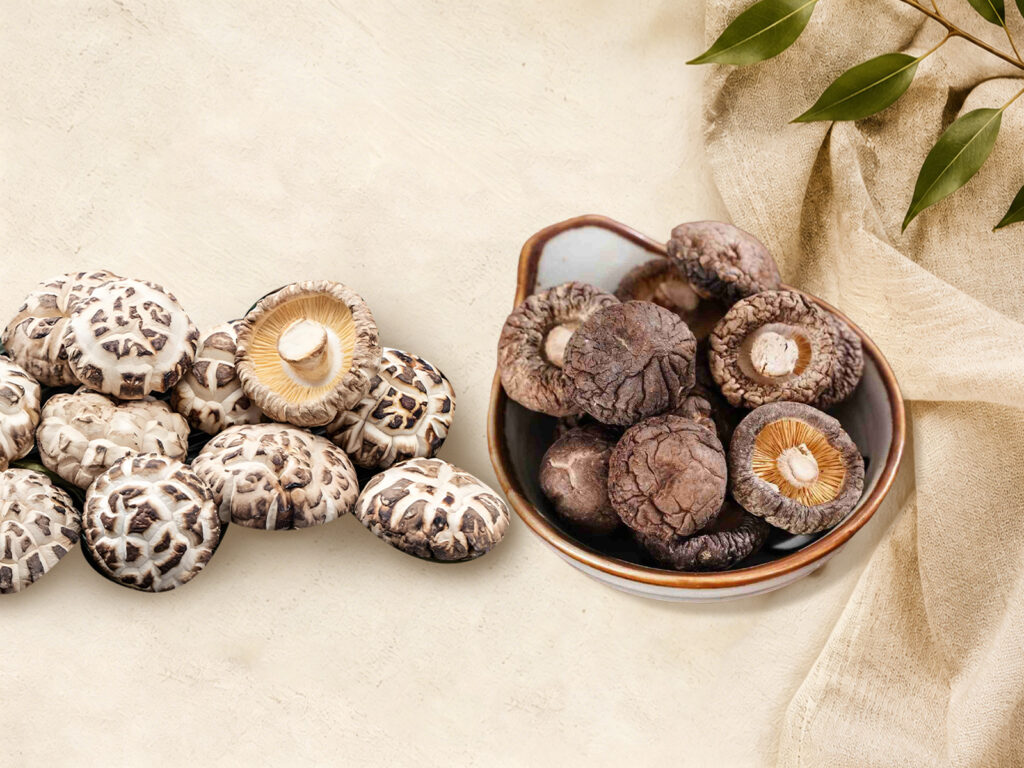
At first glance, the difference may seem simple: Flower Mushrooms have a cracked “flower” pattern on the cap, while Thick Shiitake Mushrooms have a smooth cap. However, the differences also involve appearance, thickness, texture, market positioning, and price.
Neither product is automatically better for every buyer. The right choice depends on your target market, customer preferences, application, and budget.
In this guide, we compare Flower Mushroom and Thick Shiitake to help importers make a more informed sourcing decision.
1. What Is a Flower Mushroom?

Flower Mushroom, also known as Huagu, is a premium type of dried shiitake mushroom characterized by its naturally cracked cap.
The cracks create a distinctive white pattern that looks similar to a flower, which is where the name comes from.
Flower Mushrooms are generally associated with:
- Thick and firm caps
- Natural white cracked patterns
- Strong mushroom aroma
- Rich umami flavor
- Firm texture after rehydration
- Attractive appearance
Because of their visual appeal and premium characteristics, Flower Mushrooms are often selected for retail, restaurants, gift products, and higher-end food markets.
You can also read our detailed comparison of Flower Shiitake vs Regular Shiitake for a broader understanding of shiitake categories.
2. What Is Thick Shiitake?

Thick Shiitake, commonly referred to as Hougu, is another premium type of dried shiitake mushroom.
Unlike Flower Mushroom, its cap normally has a smooth surface without the distinctive cracked pattern.
However, the absence of cracks does not mean that Thick Shiitake is a low-quality product.
Thick Shiitake can offer:
- Thick flesh
- Good texture
- Rich aroma
- Strong umami flavor
- Attractive natural appearance
- More competitive pricing than Flower Mushroom
This makes Thick Shiitake a popular choice for restaurants, food service businesses, wholesalers, and importers looking for a balance between quality and cost.
Our dried shiitake mushroom grades and sizes guide provides more information about how size, thickness, and appearance affect shiitake mushroom grades.
3. Flower Mushroom vs Thick Shiitake: Key Differences
The main differences can be summarized as follows:
| Feature | Flower Mushroom | Thick Shiitake |
|---|---|---|
| Cap surface | Natural cracked pattern | Smooth surface |
| Cap thickness | Usually thick | Thick |
| Appearance | Premium and distinctive | Clean and natural |
| Aroma | Rich and strong | Rich and pleasant |
| Texture | Firm and meaty | Firm and meaty |
| Market positioning | Premium | Premium / value-oriented |
| Typical price | Higher | More competitive |
| Main applications | Retail, restaurants, gift products | Food service, wholesale, restaurants |
| Best advantage | Appearance + premium positioning | Quality + cost efficiency |
The actual quality and price can vary according to size, grade, cultivation conditions, drying process, sorting standards, and packaging.
4. Which One Has Better Quality?
This is one of the most common questions buyers ask about Flower Mushroom vs Thick Shiitake.
The answer is: both can be high-quality products.
Flower Mushroom generally has an advantage in visual appearance because of its natural cracked pattern.
Thick Shiitake, however, can provide very similar advantages in terms of thickness, aroma, and texture while offering a more competitive price.
Therefore, importers should not judge quality based only on whether the cap has cracks.
Instead, evaluate:
- Cap thickness
- Size consistency
- Aroma
- Color
- Cleanliness
- Breakage rate
- Moisture
- Rehydration performance
For a more comprehensive quality checklist, see our guide on how to identify high-quality shiitake mushrooms.
5. Why Is Flower Mushroom Usually More Expensive?
Flower Mushroom is generally more expensive than Thick Shiitake because it has a more distinctive appearance and is positioned as a premium product.
Several factors can influence the price:
1. Lower Yield of Premium-Grade Mushrooms
Not every mushroom develops the characteristic cracked pattern required for Flower Mushroom grading.
2. Appearance
The natural flower-like cracks give the product stronger visual appeal, especially for retail and premium markets.
3. Size and Thickness
Large, thick Flower Mushrooms are particularly valuable.
4. Sorting
Premium Flower Mushrooms require careful grading and sorting, which adds processing cost.
However, price should always be compared based on the same size, grade, packaging, and quality specifications.
For more information about the factors behind dried shiitake prices, see our Dried Shiitake Mushroom Price Guide.
6. Which One Is Better for Retail?
If your customers care strongly about appearance, Flower Mushroom may be the better choice.
Flower Mushrooms are particularly suitable for:
- Supermarkets
- Premium retail
- Specialty food stores
- Gift boxes
- Premium Asian food products
The distinctive cap pattern makes the product easy to recognize and can support a higher-end market position.
For retail packaging, buyers should also pay attention to size consistency and visual presentation.
7. Which One Is Better for Restaurants and Food Service?
Thick Shiitake can be an excellent choice for restaurants and food service businesses.
Restaurants often care about:
- Strong aroma
- Good texture
- Large usable caps
- Stable supply
- Competitive cost
In these situations, the visual difference between Flower Mushroom and Thick Shiitake may be less important than cooking performance and overall purchasing cost.
For buyers serving restaurants or central kitchens, Thick Shiitake can therefore provide an attractive balance between quality and price.
8. Which One Is Better for Food Processing?
For industrial food processing, the answer depends on the final product.
If appearance is important, Flower Mushroom may be preferred.
If the mushrooms will be:
- Sliced
- Cut
- Mixed with other ingredients
- Used in prepared foods
- Processed into ingredients
then paying a premium for the flower pattern may not always provide additional value.
In this situation, Thick Shiitake or other suitable grades can offer better cost efficiency.
You can also see our guide to the top uses of dried shiitake mushrooms for more information about different applications.
9. How Should Importers Choose Between Them?
Instead of asking “Which mushroom is better?”, importers should ask:
Which mushroom is better for my market?
Choose Flower Mushroom if:
- You target premium retail customers
- Appearance is important
- You sell gift products
- You supply high-end restaurants
- Your market accepts a higher price
Choose Thick Shiitake if:
- You want a good quality-to-price balance
- You supply restaurants or food service
- Your customers focus on flavor and texture
- You need competitive bulk pricing
- Appearance is less important than cost efficiency
Some importers may choose to purchase both products and position them at different price levels.
This allows distributors and retailers to serve both premium and mainstream customers.
10. What Should You Confirm Before Placing an Order?
When purchasing either Flower Mushroom or Thick Shiitake, clearly confirm the following specifications with your supplier:
Product Specification
- Product type
- Cap size
- Cap thickness
- Grade
- Stem length
- Broken rate
Quality
- Moisture requirement
- Foreign material control
- Color
- Aroma
- Sorting standard
Packaging
- Bulk carton size
- Inner bag
- Vacuum packaging if required
- Customized retail packaging
Trade Terms
- MOQ
- FOB or CIF price
- Loading port
- Delivery time
- Payment terms
Clear specifications help prevent quality misunderstandings between buyers and suppliers.
11. Why Supplier Capability Matters
Even the same product name can represent different quality levels from different suppliers.
For example, two suppliers may both offer “Flower Mushroom,” but their products may differ in:
- Size
- Thickness
- Color
- Crack pattern
- Moisture
- Sorting
- Packaging
This is why importers should evaluate the supplier as carefully as the product itself.
A reliable dried shiitake mushroom supplier in China should be able to clearly explain product grades, specifications, quality control, packaging, and export procedures.
12. Flower Mushroom vs Thick Shiitake: Which One Should You Import?
There is no universal winner.
Flower Mushroom → Premium appearance and higher market positioning
Thick Shiitake → Strong quality with better cost efficiency
For a premium retail market, Flower Mushroom may provide stronger commercial appeal.
For restaurants, food service, wholesale, and price-sensitive markets, Thick Shiitake can often provide better value.
The best decision is to match the mushroom grade with your customer’s actual needs rather than simply choosing the most expensive option.
Final Thoughts
When comparing Flower Mushroom vs Thick Shiitake, both are valuable dried shiitake products with their own advantages.
Flower Mushroom stands out for its natural cracked appearance, premium positioning, and strong visual appeal.
Thick Shiitake offers thick flesh, good aroma and texture, and a more competitive price, making it a practical choice for many food service and wholesale applications.
For importers, the most important factors are not simply the product name or price. Size, thickness, quality, sorting, packaging, application, and supplier reliability should all be considered together.
Choosing the right specification can help importers control purchasing costs, meet customer expectations, and build a more competitive product range.
Looking for Flower Mushroom or Thick Shiitake from China?
We supply Flower Mushrooms and Thick Shiitake Mushrooms for wholesale, food service, retail, and international food businesses.
Our supply options include:
- Multiple sizes and grades
- Bulk export packaging
- OEM / private label packaging
- Professional sorting
- Stable supply
- Samples for quality evaluation
Contact us for Flower Mushroom and Thick Shiitake specifications and current export prices.